Wheel Throwing
Wheel Throwing for Beginners: Your First Pot Step by Step
Learn wheel throwing for beginners with this step-by-step guide to your first pot: wedging, centering, opening, pulling walls, and cutting off.
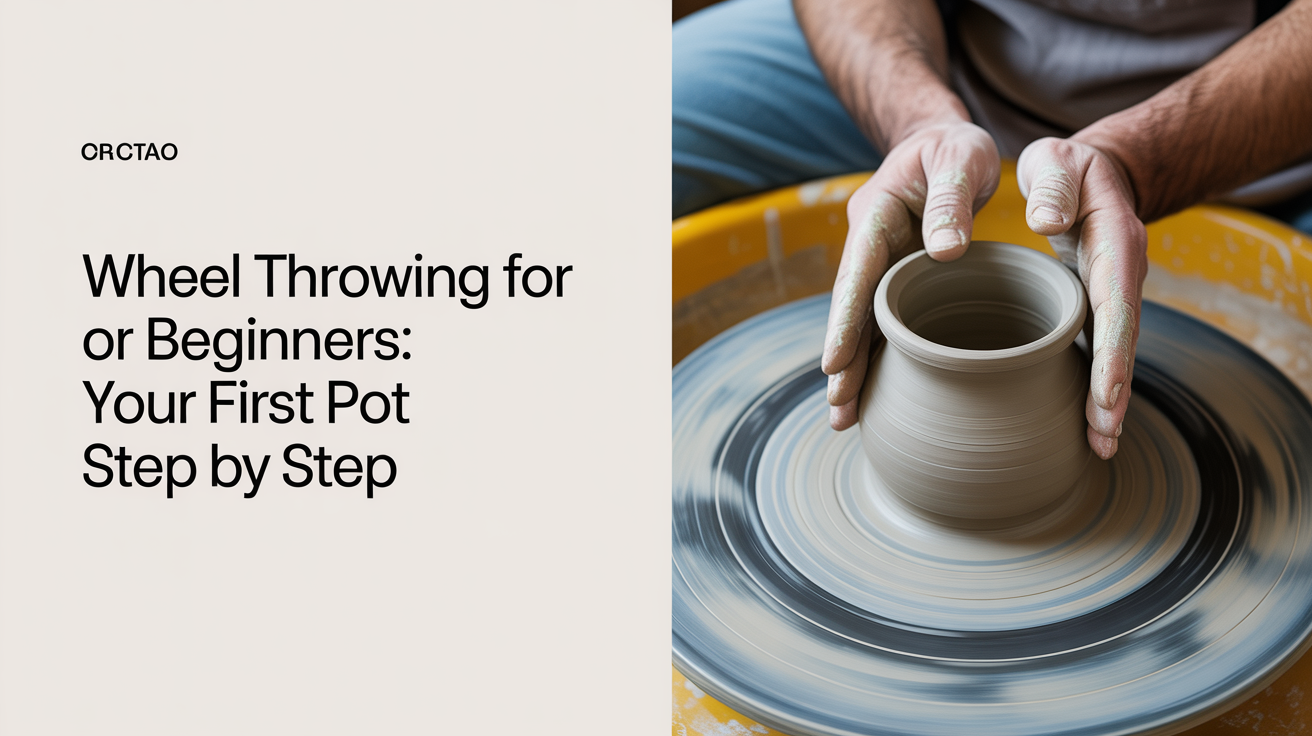
Throwing on the wheel looks like a magic act until you understand the mechanics, and then it becomes a learnable skill with a clear sequence. Most beginners can produce a recognizable cylinder in their first two or three sessions once they know what each stage is trying to accomplish. This guide walks you through the full first-pot sequence so you arrive at the wheel with a plan, not just hope.
At a Glance
- Wedge first. Skipping wedging causes tears, wobble, and trapped air that can crack a piece in the kiln.
- Start with 1 to 1.5 lb of clay. Small amounts center faster and forgive mistakes better than large ones.
- Centering, not forming, eats most of your first session. That is normal, not a sign you are behind.
- Keep the wheel at medium-high speed for centering and opening, and slow it down for pulls and the final rim pass.
- Water lubricates; it does not fix a bad center. Re-wet often, but in small amounts.
- Cut off cleanly with a wire tool and leave the piece on the bat until leather hard before you handle it.
What to Expect on Day One
Before getting into steps, it helps to set honest expectations. Wheel throwing for beginners is physically awkward at first. Your hands and the spinning clay are working against each other until you learn to anchor properly.
On your first session, expect to:
- Get your hands wet constantly (a small bucket of water near the wheel is essential)
- Have the clay wobble, collapse, or fly off the wheel at least once
- Spend most of your time just centering, not actually forming a pot
- End up with something lumpy that resembles a pot more than it doesn't
- Feel frustrated for the first 20 minutes and then start to feel the rhythm
- Use about 1 to 1.5 lb of clay per attempt and go through three or four throws
That last point matters. One pound of clay is enough for a small cup or bowl. Working small removes a lot of the struggle, because centering less clay takes less force. The table below gives a rough sense of how clay weight scales with the piece you are aiming for, so you are not guessing at how much to cut off the block.
Clay Weight to Project Size
| Clay weight | Realistic first-attempt result | Approx. finished height |
|---|---|---|
| 1 lb | Small cup or votive | 2.5 to 3 in |
| 1.5 lb | Cup or small bowl | 3 to 4 in |
| 2 lb | Mug or medium bowl | 4 to 5 in |
| 3 lb | Larger bowl or vase | 5 to 6 in |
| 5+ lb | Best left until centering is reliable | varies widely |
Weigh your clay before you wedge it if your studio has a scale. Guessing by eye is fine once you have thrown fifteen or twenty pots, but early on, a known starting weight removes one variable while you are still learning the others.
Step 1: Wedge the Clay First
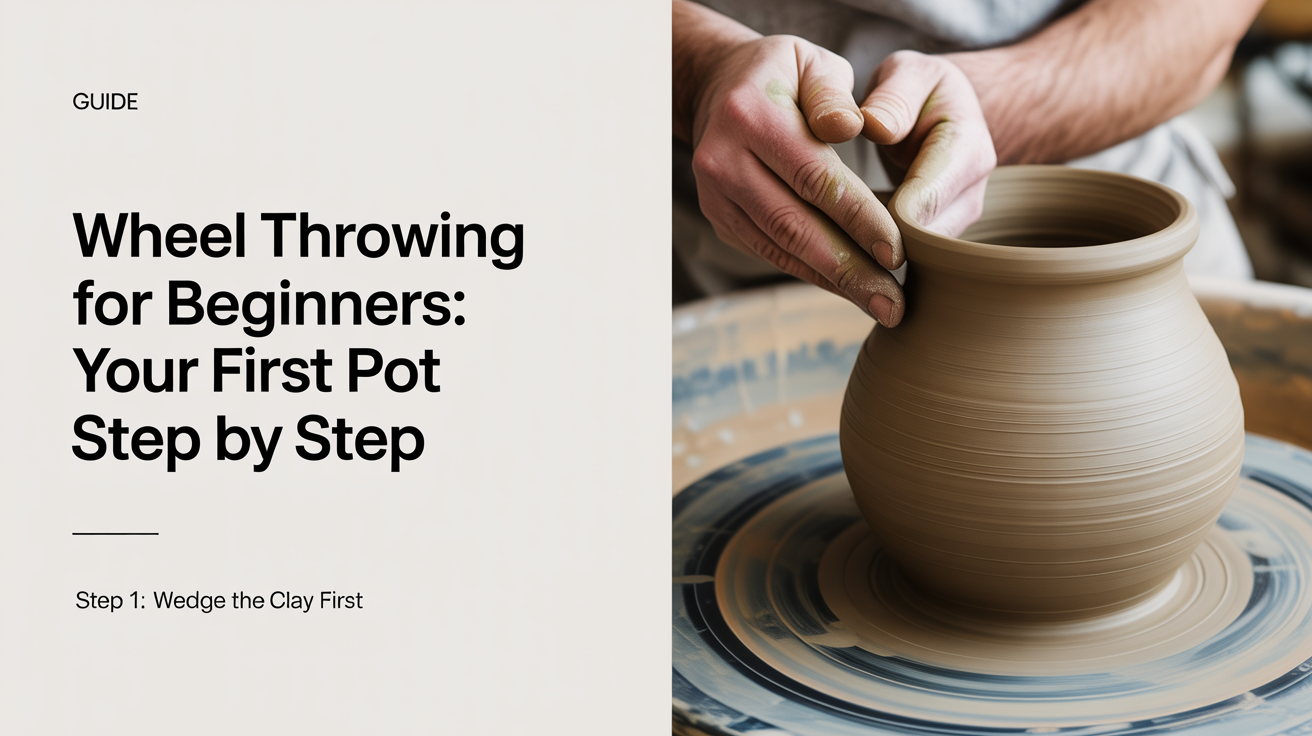
You cannot skip wedging. Air bubbles in clay cause blowouts during firing, and unevenly blended clay tears when you pull the walls. Wedging aligns the clay particles and removes trapped air before you ever touch the wheel.
For beginners, ram's head wedging is easier to learn than spiral wedging. Press the heel of your palm into the clay, push forward and down, rotate the ball a quarter turn, and repeat. Aim for 50 to 75 firm pushes. The clay should feel uniform and slightly tacky, with no sticky soft spots or stiff cold patches.
If the studio supplies clay in pre-cut bags, it may already be well-conditioned. Even so, 20 passes of wedging warms the clay and makes it noticeably more responsive on the wheel. That responsiveness has a name: plasticity, the property that lets clay change shape under pressure without springing back or tearing. Studio clay is formulated with plastic components such as ball clay so beginners have a wider margin for error, but even a plastic clay body throws better once it is warmed and evened out by wedging, as the Digitalfire reference on plasticity explains in more depth.
Step 2: Attach the Clay to the Wheel Head
Centering on a bat (a removable disc that sits on the wheel head) is strongly recommended for beginners. A bat lets you lift the finished pot off without distorting it, because freshly thrown clay is too soft to pick up by hand.
- Wet the wheel head or bat lightly.
- Slam the wedged clay ball firmly onto the center of the bat. You want it to stick.
- Press down on the clay with both palms and feel whether it sits close to center before you spin the wheel.
A rough center at this stage saves real effort later. If the clay is badly off, peel it off and re-slam it rather than fighting it. A ball slammed down within half an inch of true center might cost you thirty seconds of extra centering; one slammed down two inches off center can cost you five minutes and a sore forearm.
Step 3: Center the Clay
Centering is the skill that takes the most practice. The goal is to get the clay spinning without wobble so that every subsequent step is possible. A full breakdown of the technique is here, but the core mechanics are:
- Spin the wheel at medium-high speed (about 60 to 70% of full power for most wheels).
- Wet your hands and the clay.
- Wrap both hands around the clay and push inward with your left palm while pressing down with your right. Brace your elbows against your body or the wheel tray to create a fixed point of pressure.
- Hold steady pressure for 3 to 5 seconds, then ease off and re-wet.
- Repeat until the clay spins without wobble under your hands.
The most common mistake is pushing with arms that are floating in the air. Lock your elbows to your ribcage or your thighs. The clay wobbles because your hands wobble first. A related refinement worth knowing early: Digitalfire's guide to throwing recommends pushing the clay away from you and pulling it back toward you, rather than squeezing straight in from both sides, and cupping your hands so contact area stays small. Smaller contact area concentrates the same amount of force into a smaller patch of clay, which centers a stubborn lump faster than an open-palm push.
You will know the clay is centered when you can press a finger gently against the side and it leaves a smooth, even groove instead of a bumpy one. If the groove looks lopsided or jumps as the wheel turns, the clay is still off-center. Keep working it rather than moving to the next step early; a bad center guarantees an uneven wall later.
Step 4: Open the Clay
Opening creates the floor and inner walls of the pot. Do this with the wheel still spinning at medium speed.
- Press both thumbs together and push them straight down into the center of the clay, stopping about a half inch from the bat. That half inch becomes the floor of the pot.
- Slowly drag your thumbs outward toward you to widen the floor. Keep the movement slow and controlled.
- Check the floor thickness by pressing a fingernail straight down until you feel resistance. You want roughly a half inch of clay there.
Beginners tend to open too fast, creating a thin floor that collapses during the pull. Slow down and feel the clay. A useful decision rule: if you cannot tell how thick the floor is by feel alone, stop and check with a needle tool or fingernail rather than guessing. A floor that is too thin cannot be fixed later; a floor that stays a little thick can always be trimmed down once the pot is leather hard.
Step 5: Pull Up the Walls
This is the step that turns a lump with a hole in it into something that looks like a pot. Pulling walls correctly requires coordinated inside/outside pressure moving upward at the same rate.
- Place the fingertips of your inside hand against the inner wall, and the knuckle or fingertips of your outside hand on the corresponding spot on the outer wall.
- Squeeze gently inward with the outside hand while lifting both hands slowly upward together.
- Stop before you reach the rim. Release pressure before your hands leave the clay.
- Re-wet your hands and repeat. Three to four pulls typically builds enough height for a small cup.
Keep the wheel speed at medium during pulls. Too fast and the clay spirals. Too slow and your hands drag it out of round.
The wall should feel even under your fingertips. If it thins dramatically at one spot, that spot will tear on the next pull. Ease off and compress that area before continuing. As a rough benchmark, a beginner's first successful cylinder usually has walls between 1/4 and 3/8 inch thick after the second pull, and closer to 1/8 inch by the fourth. If your walls are still near a half inch after three pulls, you are likely squeezing too gently and need firmer, slower pressure rather than more pulls.
Step 6: Shape and Refine
Once the walls are up, you have a basic cylinder. From here you can:
- Leave it as a cylinder, which is the correct shape for a mug or tall cup
- Belly it outward by pressing gently from the inside at mid-wall height while the wheel turns slowly
- Narrow the top (collar) by cupping both hands around the top of the pot and squeezing inward with slow wheel speed
Keep the rim flat and even by pressing down gently with a wet finger as the wheel turns. A wobbly rim is hard to fix later and catches eyes in the finished piece.
Compress the floor one more time with a finger or a wooden rib to prevent the base from cracking during drying. This final compression matters more than it looks: a floor that was opened correctly but never re-compressed after shaping can still develop an S-crack as it dries, because the clay particles near the center were disturbed and never realigned.
Step 7: Cut Off and Let It Dry
When the pot feels done, slow the wheel to its lowest speed.
- Hold a wire tool taut between both hands and slide it under the pot, keeping it flat against the bat.
- Slide the wire all the way through in one smooth pass.
- Leave the pot on the bat and set it aside on a shelf, out of direct airflow.
Do not try to move the pot off the bat while it is wet. Let it reach leather-hard stage, which typically takes several hours to overnight depending on humidity and wall thickness. At leather-hard, the clay is stiff enough to handle without distortion, and you can trim the foot ring if you want a clean base.
Frequently Asked Questions
How much clay should a beginner start with?
Start with 1 to 1.5 lb of clay. Smaller amounts center more easily and let you focus on technique rather than fighting the mass. As your centering gets solid, move up to 2 lb, then 3 lb. There is no advantage to working large until the fundamentals are automatic.
Why does my clay keep wobbling no matter what I do?
Wobble almost always comes from hands that are not anchored. Your hands move, so the clay moves. Brace your elbows against your body or the wheel tray, and hold pressure for longer stretches instead of tapping repeatedly. Also check that your clay was wedged evenly. Stiff patches in the clay cause it to resist centering in specific spots.
How wet should the clay be during throwing?
Wet enough that your hands glide without dragging, dry enough that the clay does not feel soupy. Add water frequently in small amounts. A mistake beginners make is adding too much water at once, which weakens the clay walls. Keep a small sponge in your water bucket and squeeze on just enough to lubricate each pass. Most throwing clay bodies are formulated for roughly 20 to 22 percent water content by weight at throwing consistency, and the water you add at the wheel is topping up surface lubrication, not changing that underlying ratio in any meaningful way for a single throw.
My walls keep tearing when I pull. What am I doing wrong?
Tearing usually means the wall is too thin in one spot, or you are squeezing too hard with the outside hand. Slow the pull down and reduce pressure. Also make sure you are pulling upward rather than outward. Pulling outward thins the wall and eventually tears it. If the clay is tearing consistently, try wedging a fresh piece and starting over rather than trying to rescue a compromised wall.
How long does it take to get good at wheel throwing?
Most people find that basic control comes after 10 to 15 hours of focused practice. That means you can center reliably and pull a recognizable cylinder. Consistency, thin walls, and refined shapes take considerably longer. The wheel rewards repetition, so throwing the same form (a simple cup) many times in a row builds skill faster than trying different shapes each session.
Is it normal to fail on almost every attempt at first?
Yes. Collapsed walls, off-center clay, and pots that fold over on themselves are part of learning, not a sign you lack the hand strength or coordination for wheel throwing. Reclaim the clay, wedge it, and try again. Most instructors expect a beginner's first session to produce more scrap than finished pieces, and that ratio flips within a handful of sessions once centering becomes reliable.