Getting Started
How Long Does It Take to Learn Pottery? A Realistic Timeline
A realistic timeline for learning pottery, from your first pinch pot to confident wheel throwing. Honest benchmarks for beginners at every stage.
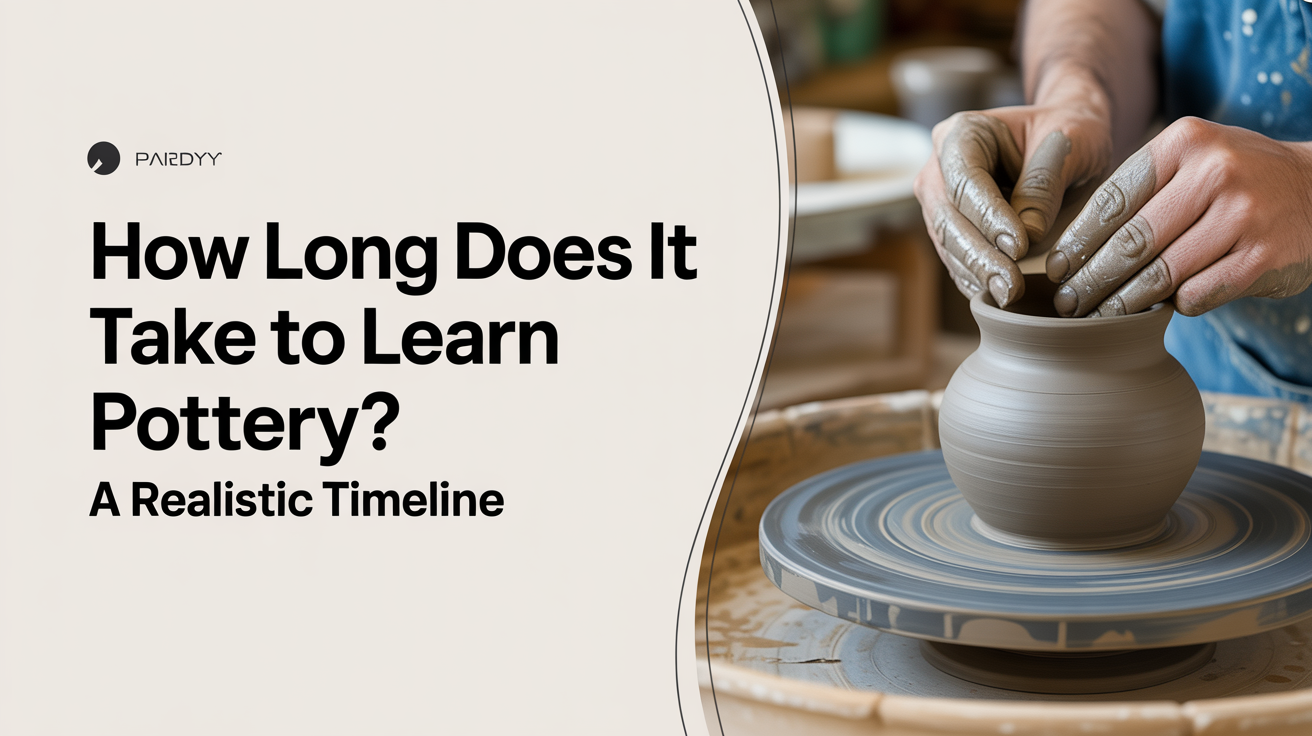
Most beginners ask this question before they've touched clay, and the honest answer is: you can make something recognizable in your first session, but it takes six months to a year of regular practice before throwing on the wheel feels like something you control rather than something that controls you. Hand-building gets usable results faster. The wheel takes longer. Both reward you continuously along the way.
Below is a stage-by-stage breakdown of what to expect, when to expect it, and what actually slows people down.
What "Learning Pottery" Actually Means
Before talking timelines, it helps to split pottery into its main tracks, because they have very different learning curves.
Hand-building covers pinch pots, coil building, and slab work. You shape clay by hand or with simple tools, no wheel required. A functional pinch pot is achievable in a single afternoon. A clean slab box with fitted lid takes most people a few weeks of practice to pull off reliably.
Wheel throwing is what most beginners picture when they think of pottery. You center a ball of clay on a spinning wheel and pull up walls. Centering alone takes the majority of beginners three to six hours of focused practice before it starts clicking. Pulling consistent walls can take weeks more. Many people spend their first two or three classes just trying to center.
Glazing and firing are their own skill sets on top of the forming work. You can learn basic brush glazing quickly, but understanding how glazes interact, move, and transform in a kiln is a longer study. If you are taking a studio class, your instructor handles the firing; if you are setting up at home, factor in time to learn kiln operation separately.
If you are just starting out and want to understand the full landscape before committing, pottery for absolute beginners covers all of this in one place.
The Learning Timeline, Stage by Stage
Stage 1: First Contact (Sessions 1 to 3)
Your first few sessions are about getting clay in your hands and discovering what it does. You will probably make a lopsided pinch pot or a small coil bowl. These pieces may crack during drying or warp in the kiln. That is normal.
What you actually learn at this stage: how clay feels when it is too wet versus too stiff, how to join pieces without them falling apart, and the basic rhythm of working before clay dries out on you.
Wheel throwing at this stage: centering is disorienting for almost everyone. The clay seems to have its own agenda. Expect to watch a lot of it fly off the wheel or collapse before you open your first cylinder.
Stage 2: Getting Consistent (Months 1 to 3)
After a few weeks of weekly practice (one to three sessions per week), most people can:
- Make pinch pots and simple coil or slab pieces with reasonable control
- Open clay on the wheel and pull up a short cylinder, even if walls are uneven
- Trim a basic foot on a leather-hard piece
- Apply glaze without obvious drips or bare patches
This is the stage where hand-builders and wheel throwers diverge in progress speed. Hand-builders are already producing pieces they want to keep. Wheel throwers are still fighting with centering and wall thickness.
Stage 3: Building Real Control (Months 3 to 12)
This is where most of the visible progress happens on the wheel. By the six-month mark with regular practice, most beginners can:
- Center clay reliably without spending ten minutes fighting it
- Pull a cylinder with reasonably even walls
- Make a basic bowl or small mug that holds its shape through drying and firing
- Start trimming footrings with some precision
"Regular practice" here means at least one to two studio sessions per week. Someone who goes once a month will be somewhere in Stage 2 for a long time, and there is nothing wrong with that pace if it suits your life.
Hand-builders at this stage are often making functional pieces: mugs, plates, planters, small vases. The ceiling is high. Slab work in particular gets sophisticated quickly once you understand how clay moves as it dries.
Stage 4: Confident Beginner to Early Intermediate (Year 1 to 2)
By the end of the first year of consistent practice, most people describe the wheel as starting to feel like a tool rather than a puzzle. You stop losing pots to centering errors. You develop a consistent opening move. You start thinking about form instead of just survival.
Second year is when things like:
- Throwing taller forms
- Throwing off the hump (making multiple small pieces from one lump)
- Consistent lid fits
- Intermediate surface decoration
...come into reach for most people.
How Hard Is Pottery to Learn?
Pottery is genuinely difficult in the early stages on the wheel, not because the technique is complicated, but because you are training physical memory. Reading about centering does not help you center. Watching videos does not either, except to give you a mental model to aim for.
The physical coordination needed for wheel throwing, where your hands, foot pressure, and body posture all work together, takes repetition to groove in. Most people find the first month frustrating at some level.
Hand-building is more immediately approachable. The skills are closer to things you have already done (rolling dough, building with blocks), so the early feedback loop is faster and more encouraging.
Neither track requires unusual talent. People who say they "have no artistic ability" consistently surprise themselves. The main predictor of progress is how often you show up and handle clay.
What Slows Progress Down
A few things consistently delay people's development:
| Factor | What actually happens |
|---|---|
| Infrequent practice | Muscle memory fades between sessions; centering resets every time |
| Too-wet clay | Walls collapse before they get height; beginners add water thinking it helps |
| Skipping reclaim and wedging | Air pockets cause explosions in the kiln and teach bad habits |
| No feedback | Self-taught beginners repeat the same inefficient movement for months |
| Wrong clay body | Grogged stoneware is forgiving; smooth porcelain punishes early technique |
Classes or open studio sessions with an instructor you can ask questions of are significantly faster routes than solo practice from videos, at least for the first three months.
If you are thinking about setting up a space to practice at home, read through how to set up a small pottery studio at home before buying equipment. Your needs at six weeks in are different from your needs at six months.
Wheel vs. Hand-Building: Which Is Faster to Learn?
If your goal is making functional pieces you are happy to give to people, hand-building gets you there in weeks. If your goal is throwing on the wheel, budget six months to a year before you feel genuinely in command of the process.
This does not mean you should avoid the wheel if that is what draws you. It means setting realistic expectations so you do not quit at the two-month mark when things are hardest.
One approach that works for many beginners: start with hand-building to develop clay intuition (how to join, how thick to leave walls, how to think about drying), then move to the wheel. The fundamentals transfer more than you might expect.
If you are still deciding between the two, do you need a pottery wheel to start works through the practical tradeoffs in detail.
Frequently Asked Questions
Can I learn pottery on my own without classes?
Yes, but it takes longer on the wheel, where feedback on your hand position and body mechanics is harder to self-diagnose. Hand-building is more self-teachable. If you are going the self-taught route, filming your sessions and watching them back helps you spot what you cannot feel in the moment.
How many hours does it take to get good at pottery?
There is no clean number, because "good" means different things. Making functional work you are proud of: somewhere in the range of 40 to 80 hours of hands-on clay time for most people. Making work that looks deliberate and controlled rather than charming-but-wobbly: closer to 200 hours or more on the wheel. These are rough ranges, not targets to optimize toward.
Is pottery hard to learn compared to other crafts?
Wheel throwing is one of the harder physical crafts to pick up because it requires training muscle memory for coordinated movements that do not come naturally. Hand-building is comparable in difficulty to leather tooling or basic woodworking: there is technique to learn, but you can produce satisfying results fairly quickly. Neither requires artistic training or previous craft experience.
What is the hardest part of learning pottery?
For wheel throwers, centering is almost universally cited as the first major wall. Once centering becomes reliable, the challenge shifts to pulling consistent wall thickness. For hand-builders, getting joins to stay together through drying is the most common early failure point.
At what point do people usually quit?
The highest dropout point for wheel throwing is around the first month. This is when the gap between expectations (graceful, meditative, results-oriented) and reality (clay flying, cylinders collapsing, wrists sore) is biggest. People who push through to month two or three almost always keep going.