Firing & Kilns
Understanding Pyrometric Cones and Firing Schedules
Learn how pyrometric cones work, what witness cones tell you, and how to build a firing schedule that matches your clay and glaze.
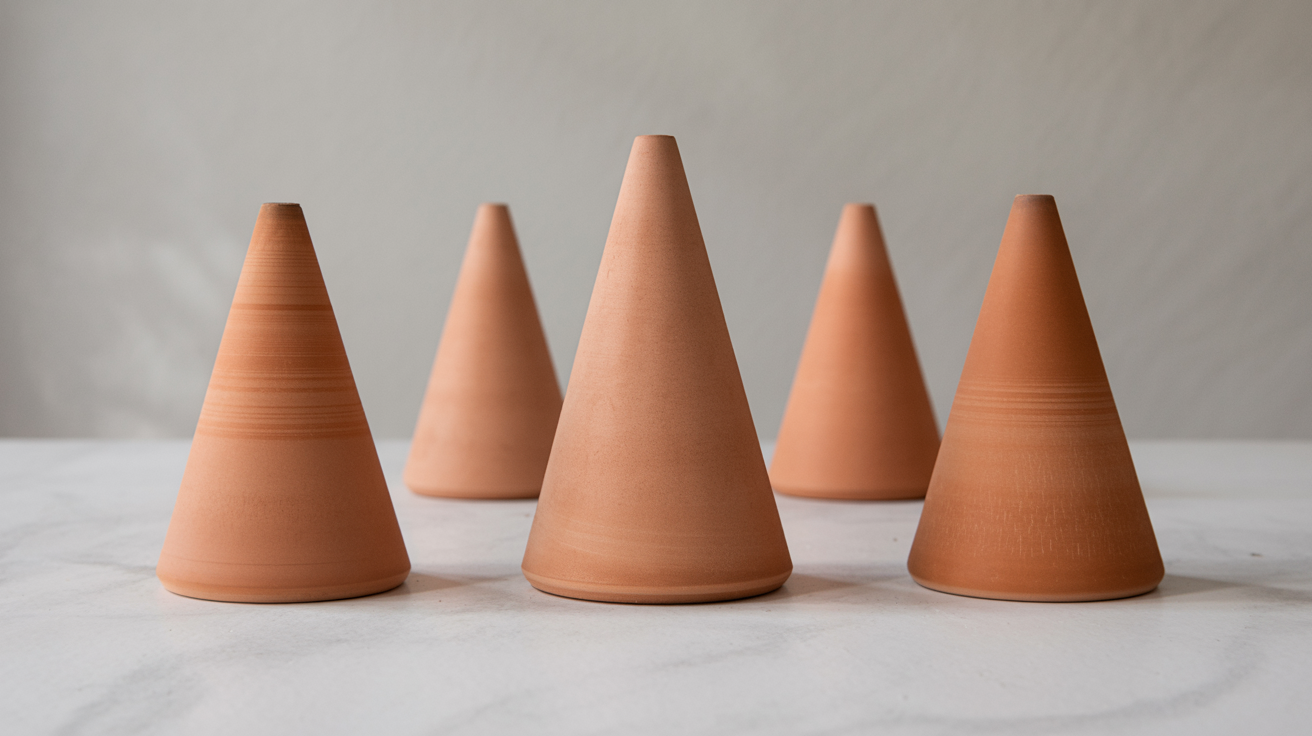
A pyrometric cone is a small, three-sided pyramid of ceramic material that softens and bends at a specific temperature range inside the kiln. Potters use them to confirm that a firing reached the right amount of heat work, a combination of temperature and time, rather than relying on a thermocouple reading alone. This guide explains how cones work, how to read them, and how to put a firing schedule together that gets your clay and glazes to maturity.
What Pyrometric Cones Actually Measure
Temperature and heat work are not the same thing. A kiln thermometer tells you the air temperature near the thermocouple, but the clay body and glazes respond to the total energy absorbed over the whole firing, not just the peak number on the controller screen.
Cones are made from ceramic compounds calibrated to absorb a set amount of heat work and then slump. When you see a cone tip touch down to kiln-shelf level, you know the ware in that zone of the kiln has received the energy it needed. A cone sitting straight up means the firing fell short. A cone melted flat means things went too far.
Cone numbers cover a wide range. Low-fire glazes typically mature between cone 022 and cone 02 (roughly 580°C to 1100°C). Mid-fire sits around cone 4 to cone 6 (1186°C to 1222°C). High-fire stoneware and porcelain usually fire to cone 9 or cone 10 (1260°C to 1285°C). Cones below cone 1 use a descending numbering system with a zero prefix, so cone 06 is cooler than cone 6, a small detail that trips up almost every beginner.
How Do Pottery Cones Work in Practice
Cones come in two main forms: self-supporting cones (sometimes called junior or small cones) and the taller standard cones. Self-supporting cones have a built-in base so they stand on their own on a kiln shelf. Standard cones need to be pressed into a clay pad or a commercial cone holder at the correct angle, usually 8 degrees off vertical.
The bent angle of a finished cone tells you how the firing went:
| Cone position after firing | Meaning |
|---|---|
| Standing straight | Underfired, kiln shut down too early or too cool |
| Tip just touching shelf | Target reached, ideal for most schedules |
| Bent to 90 degrees | Slightly over, monitor your next run |
| Melted flat | Significantly overfired |
When you open the kiln after a successful bisque or glaze firing, read each cone before you unload. Keep a simple log: date, cone target, what the witness cones showed, any observations about the finished ware. That record becomes your most useful tool as you dial in the kiln.
Witness Cones and How to Set Them Up
Witness cones are the cones you place inside the kiln with your actual ware to observe what happened in that particular zone. A kiln controller with a thermocouple is useful, but the thermocouple sits in one spot and cannot tell you whether the back corner or the bottom shelf fired the same as the middle. Witness cones placed in several locations give you that information directly.
A standard witness cone pack uses three cones: the guide cone (one cone number below target), the firing cone (target), and the guard cone (one cone number above target). After firing, the guide cone should be bent flat or nearly so, the firing cone bent to about 90 degrees with the tip touching the shelf, and the guard cone still standing. If your guard cone is bent, you overfired.
Place a witness pack at the top, middle, and bottom of the kiln until you know how your particular kiln distributes heat. Some kilns run hotter at the top; others are hotter at the bottom. Once you understand your kiln's behavior, you can adjust shelf placement or firing schedules to compensate. See how a pottery kiln works: a beginner's guide for a walkthrough of the different kiln types and where heat differences tend to appear.
Building a Firing Schedule for Pottery
A firing schedule is a set of programmed segments telling the kiln controller how fast to raise temperature, at what pace, and whether to hold at any point. Most digital controllers let you enter multiple segments: a rate in degrees per hour, a target temperature, and an optional hold time in minutes.
A basic bisque firing for earthenware or stoneware might look like this:
- Segment 1 (candling): Ramp to 120°C at 27°C per hour, hold for 30 minutes. This drives off any remaining moisture slowly so pieces don't crack or explode.
- Segment 2 (quartz inversion): Ramp from 120°C to 600°C at 100°C per hour. Silica in the clay goes through a structural change around 573°C; slower rates here reduce stress cracking.
- Segment 3 (body burnout): Ramp from 600°C to target (cone 06 or 04 for bisque) at 150°C per hour. Organic materials in the clay burn off during this phase; good kiln ventilation matters here.
- Hold at peak: 10 to 15 minutes at target temperature. This lets heat equalize through the load before the controller shuts off.
Glaze firings for mid-fire or high-fire work often climb faster in the middle ranges but slow again near peak to let glazes melt evenly. A typical cone 6 glaze schedule might ramp at 100°C per hour below 600°C, then 150°C per hour from 600°C to 1100°C, then slow to 55°C per hour from 1100°C to peak at around 1222°C, with a 10-minute hold. Cooling is usually uncontrolled (the kiln just cools on its own) unless you are working with glazes prone to crazing, in which case a controlled slow-cool helps.
For the differences between a bisque run and a glaze run, including why the sequences matter, see bisque firing vs glaze firing: what each one does.
Always check your clay body manufacturer's recommended cone range and any specific firing notes for your glazes. A schedule that works perfectly for one clay body may leave another underfired or bloated. This is especially true when firing pieces with very different wall thicknesses in the same load.
Getting Your Ware Ready Before the Kiln Even Turns On
A firing schedule cannot fix problems that start before loading. Pieces with trapped moisture are the most common source of cracks and explosions in a bisque firing. Even work that feels dry to the touch can hold moisture in thick sections.
The standard check is to hold the piece briefly against your cheek: if it feels cool, water is still evaporating. Let it warm to room temperature before you fire. For thick-walled work or pieces made in a humid studio, additional drying time near a heat source helps.
Loading also affects results. Leave space between pieces for air to circulate. Avoid stacking greenware directly on top of each other in a bisque firing. During glaze firing, keep pieces from touching and check that no glaze drips onto the shelf (a kiln wash coat on shelves prevents most cleanup headaches). For more detail on the drying stage, see how to dry pottery before firing so it doesn't crack.
Frequently Asked Questions
What cone should I use for bisque firing? Most potters bisque fire earthenware to cone 06 or 04 and stoneware to cone 06 or 08. Bisque is fired to a lower temperature than the final glaze firing so the clay is still porous enough to absorb glaze during dipping or brushing. Check your clay body's data sheet for the manufacturer's recommended bisque cone.
Can I skip witness cones if my kiln has a digital controller? You can, but it is worth using them at least occasionally to verify that your controller and thermocouple are accurate. Thermocouples drift over time and may read slightly high or low. A witness cone pack once every several firings gives you an independent check on what the ware actually experienced.
What happens if I fire to the wrong cone by accident? If you underfire a glaze firing, the glazes may look rough, matte, or pinholy, and the clay body will be weaker than intended. You can often refire underfired work by loading it back in the kiln and running a full firing again. Overfiring is harder to fix: glazes can run onto shelves, clay can bloat or warp, and glaze colors may shift beyond what you wanted. Prevention through accurate cone placement and careful schedule programming is much easier than recovery.
How do I know if a clay body and glaze are a good fit at the same cone? Both need to mature at the same temperature range. Check the cone rating on the clay body bag and the cone range listed by the glaze manufacturer. Mismatched combinations lead to underfired clay with a properly melted glaze, or properly fired clay with a glaze that has gone too far. Testing small test tiles before committing a full kiln load is the standard way to confirm compatibility.
Do firing schedules change for electric vs. gas kilns? Yes, in one important way. Electric kilns fire in an oxidation atmosphere because oxygen is freely available. Gas kilns can be fired in reduction by limiting the air intake, which changes glaze colors (for example, iron glazes shift from yellow-brown to celadon green in reduction). The temperature schedules follow similar principles, but reduction adds the task of timing when and how heavily to reduce and affects which clay bodies and glazes give good results. If you're starting out, an electric kiln and an oxidation schedule is the simpler entry point.