Clay & Materials
The Beginner's Pottery Tool Kit, Explained Tool by Tool
A clear breakdown of the pottery tools every beginner needs, what each one does, and which to buy first before spending on extras.
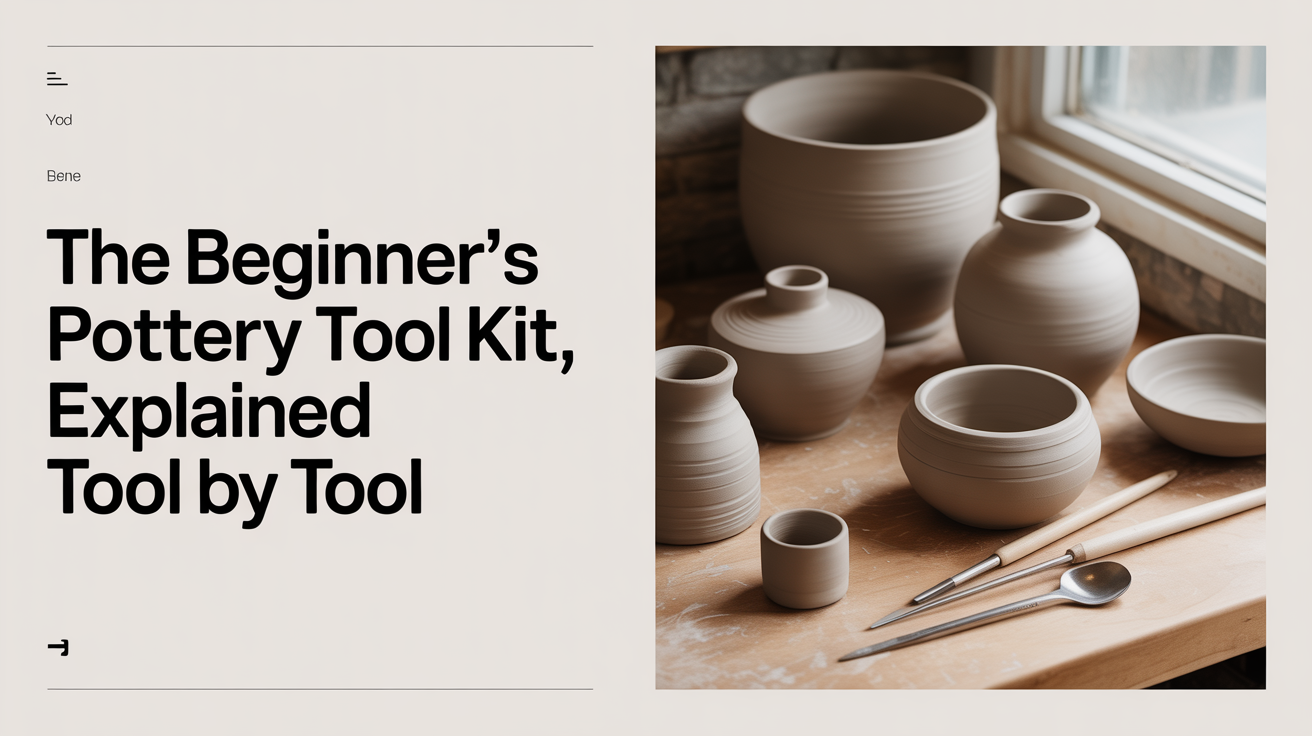
Walk into a pottery supply shop and the tool wall can look baffling. Ribs, loop tools, needle tools, bats, wire tools, sponges on sticks. The good news: you need maybe five or six things to start making real work, and most of them cost less than a lunch. This guide names every common tool, explains exactly what it does, and tells you which ones to buy first.
The Core Pottery Tool Kit (What You Actually Need)
These are the tools worth buying before anything else. Every other tool on the wall is either a specialist item or a convenience upgrade you can add once you know you'll stick with it.
Wire Tool
A wire tool is two wooden toggles connected by a twisted wire or plain wire. You press the toggles to the work surface, pull the wire through the base of a lump of clay, and it cuts cleanly. You use it to cut clay off a block, to remove a finished piece from a bat or wheel head, and to slice test wedges to check for air pockets. Cost: around $3.
Needle Tool
A needle tool (also called a pin tool) is a thick metal needle set into a wood or rubber handle. It scores clay before joining two pieces, trims uneven rims, tests wall thickness, and pierces holes. If you could only have two tools, the wire tool and the needle tool would be them.
Wooden or Rubber Rib
The rib is the tool beginners ask about most. A rib is a flat or curved piece of wood, rubber, or metal that you hold against the clay surface to smooth, compress, shape, or thin it. On the wheel, you press a rib against the outside wall while your other hand supports from inside, and the combination pushes water off the surface and compresses the clay. Off the wheel, a rib smooths slab seams and coil joins.
Wood ribs are usually kidney-shaped with a mix of convex and concave curves. Rubber ribs are softer and flex against curved surfaces. Metal ribs are rigid and can scrape very cleanly. Buy one wood or rubber rib to start; it is the most versatile shaping tool in the kit.
Loop and Ribbon Tools
Loop tools and ribbon tools are wire loops or flat metal ribbons set into a handle at different angles. You drag them through soft leather-hard clay to remove material. They are the main trimming tools for cleaning up the foot of a thrown piece, hollowing the base of a sculpture, or carving texture. A basic set of two or three loop tools covers most needs.
Sponge
A natural or synthetic sponge absorbs water so you can add moisture to the clay surface while throwing, and remove water from inside a vessel at the end. A sponge on a stick (sometimes sold as a "throwing sponge") lets you reach the bottom of a deep form without putting your whole arm in. This is one of the cheapest purchases you will make and one of the most useful.
Banding Wheel (Optional but Highly Useful)
A banding wheel is a simple turntable you set on a table or wedging board. It is not motorized. You put a piece on it and spin it by hand to look at all sides evenly, to apply underglaze or slip in even bands, or to trim. Strictly speaking it is not a hand tool, but it belongs in any beginner kit list because it makes hand-building and decorating so much easier.
Names of Pottery Tools: A Quick Reference
| Tool Name | What It Looks Like | What You Use It For |
|---|---|---|
| Wire tool | Wire between two toggles | Cutting clay off the block, removing thrown pieces |
| Needle tool | Long needle in a handle | Scoring, trimming rims, testing wall thickness |
| Rib (wood) | Kidney-shaped flat piece | Smoothing and shaping walls on and off the wheel |
| Rib (rubber) | Flexible curved blade | Smoothing curved surfaces, removing throwing lines |
| Loop tool | Wire loop on a handle | Trimming the foot ring, carving leather-hard clay |
| Sponge | Natural or synthetic sponge | Adding moisture while throwing, soaking up puddles |
| Fettling knife | Small, thin blade | Cutting slabs, trimming greenware edges |
| Sgraffito tool | Fine-pointed scraper | Scratching designs through slip or underglaze |
| Banding wheel | Hand-powered turntable | Decorating, inspecting, hand-building |
| Bat | Flat disc (wood or plastic) | Throwing on; removes from wheel without touching the piece |
What Is a Rib Tool in Pottery (and When to Use One)?
A rib tool is simply any flat or curved scraper used to shape and refine clay. The name comes from the original animal rib bones that potters used for exactly this purpose. Today ribs come in wood, rubber, and metal, and each material has a slightly different feel and use.
Wood ribs are good for general shaping on the wheel and smoothing slab surfaces. They absorb a small amount of water, which helps them grip the clay slightly.
Rubber ribs are more forgiving on rounded forms. They flex to follow the curve of a bowl or vase and are gentle enough to use on thin walls without causing the wall to flex and collapse.
Metal ribs are the stiffest. They leave a very smooth, almost polished surface and are used to remove throwing lines, tighten the form, and prep surfaces for slip or underglaze. Some metal ribs have serrated or notched edges for adding texture.
When throwing on the wheel, a common technique is to hold a rib on the outside wall with one hand while the fingers of the other hand press from inside. You are squeezing the wall between your fingers and the rib at the same time as the wheel turns, which compresses the clay and refines the shape in one motion. On a slab, you might drag a rib across the surface diagonally, then diagonally the other way, to smooth without trapping air under the clay.
Tools for Joining and Scoring
Joining two pieces of clay requires scoring and slip. Scoring means scratching a crosshatch pattern into both surfaces before you press them together. A needle tool works for this, and so does a serrated rib or a dedicated scoring tool (sometimes just a short piece of hacksaw blade set into a dowel). After scoring, you brush both surfaces with slip (liquid clay) before pressing the join.
If you are hand-building, you will use this technique constantly. Learning to score and slip properly is more important than owning any special tool. See what clay should a beginner buy first for guidance on which clay bodies are most forgiving during joins.
Tools for Cutting and Trimming
A fettling knife is a thin, flexible blade in a wood handle. It cuts slabs, trims greenware edges, and cleans up seams. Some potters use a craft knife or X-Acto knife instead; both work fine.
A Surform tool (a small rasp-like file) removes clay quickly from leather-hard pieces. It looks like a cheese grater and works in the same way. Good for reshaping hand-built pieces that have stiffened before you finished them.
A hole cutter (round or shaped) punches clean openings for spouts, drainage holes, or decorative patterns. You can cut holes with a needle tool, but a hole cutter is faster and more consistent for multiples.
What to Skip Until You Know You Need It
Once the core tools are in your kit, it is easy to keep adding. Here is what to hold off on:
- Extruder: Useful for making coils and tubes quickly, but bulky and expensive. Coils pulled by hand teach you more in the first year.
- Slab roller: Saves time on large slabs. A rolling pin and two guide sticks (same thickness) do the same job for free to start.
- Texture stamps and rollers: Fun, but not something you need before you know how to wedge, build, and join consistently.
The clay body you choose affects how every tool performs. A grogged stoneware will blunt fine loop tools faster than a smooth porcelain. For more on choosing clay, see types of clay for pottery: earthenware, stoneware, and porcelain explained and what is grog in clay and when do you want it.
Frequently Asked Questions
What pottery tools do I need to start hand-building? At minimum: a wire tool, a needle tool, a wood or rubber rib, and a sponge. A fettling knife and a loop tool will cover almost every other step. You can hand-build an entire piece with this group and nothing else.
What is the difference between a wood rib and a rubber rib? Wood ribs are more rigid and better for shaping flat or gently curved surfaces. Rubber ribs flex, so they follow the curve of a bowl or cylinder and are easier to use on thin walls. Most potters keep both and switch depending on the stage and form.
Do I need different tools for wheel throwing vs. hand-building? The core tools overlap heavily. The wire tool, needle tool, rib, and sponge are useful for both. The main hand-building extras are a fettling knife and a scoring tool. The main wheel-throwing extras are a bat, a throwing sponge on a stick, and a set of trimming loop tools.
Can I use household items instead of buying tools? Yes, for several. A butter knife works as a scoring tool. An old credit card makes a passable rib. A kitchen sponge cuts to size. A piece of wire and two dowels is a wire tool. Where household items fall short is precision trimming, which really does go better with a proper loop tool.
How do I keep pottery tools in good shape? Rinse metal tools after every session. Dry them before storing to prevent rust. Keep wood ribs away from long soaks in water, which can cause them to swell and crack. Store loop tools so the wires do not press against each other and bend out of shape.