Clay & Materials
Air-Dry Clay vs Kiln-Fired Clay: What's the Difference?
Air-dry clay and kiln-fired clay look similar in the bag, but they behave completely differently. Here's what beginners need to know before choosing.
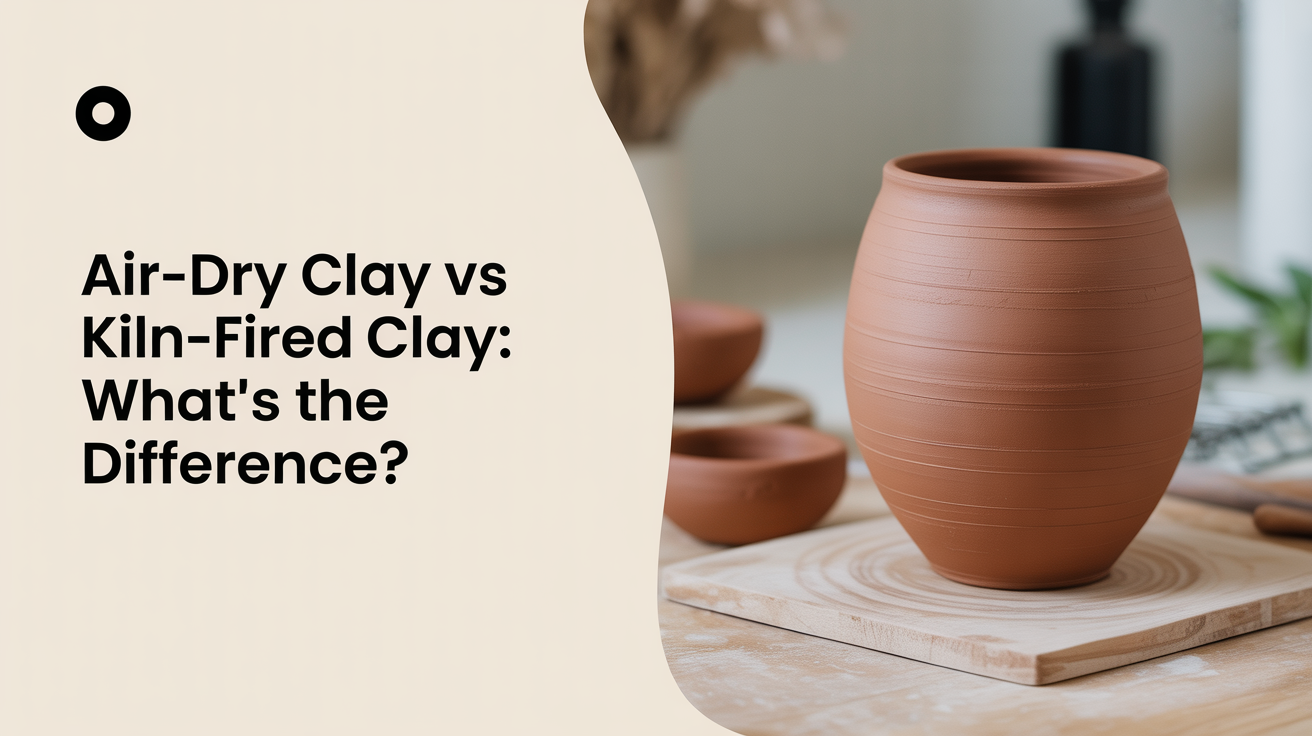
Air-dry clay and kiln-fired clay are sold side by side in craft stores, and both feel like clay straight from the bag. The difference shows up after you finish a piece. Air-dry clay hardens when water evaporates at room temperature. Kiln-fired clay goes through a chemical transformation at high heat that air alone cannot replicate. That distinction affects everything: durability, waterproofness, how the surface accepts decoration, and whether your finished piece can hold liquid.
What Air-Dry Clay Actually Is
Air-dry clay is a modeling material, not a traditional pottery clay. Most air-dry formulas are built around a paper pulp or cellulose fiber base mixed with binders. The clay dries by releasing moisture into the air, similar to how plaster sets, but without heat.
The result is lighter and more fragile than fired stoneware. Air-dry pieces are genuinely porous unless you seal them with a waterproof varnish. Even then, prolonged contact with water softens or re-hydrates the surface over time. A cup or bowl made from air-dry clay is decorative, not functional for liquids.
Air-dry clay is a reasonable starting point for sculpture, armatures, and decorative pieces where you want to build without access to a kiln. It is not real pottery in the traditional sense, though it can look convincing once painted.
What Kiln-Fired Clay Is (and Why the Kiln Matters)
Kiln-fired pottery clay is a natural mineral material: silica, alumina, and various flux minerals in different ratios depending on the clay body. When you fire it to temperatures between roughly 1800°F and 2400°F (982°C to 1316°C), a permanent chemical change takes place called vitrification. The clay particles fuse. Water can no longer enter or leave through the structure.
This is why wheel-thrown mugs hold coffee without leaking, and why ancient pottery survives in archaeological sites. The firing, not the drying, is what makes clay permanent and water-resistant.
Kiln-fired clay bodies come in three main types with different characteristics and firing temperatures. If you want to go deeper on that, types-of-clay-for-pottery-earthenware-stoneware-and-porcelain-explained covers how earthenware, stoneware, and porcelain differ and when each makes sense for a beginner.
How Polymer Clay Fits In
Polymer clay is a third category that often gets lumped into this conversation. It is not natural clay at all. Polymer clay is made from PVC particles and plasticizers that firm up in a home oven at temperatures around 230-275°F (110-135°C), far below what pottery clay needs.
Polymer clay does not shrink much, holds fine detail well, and comes in a wide range of colors you can mix. It is popular for jewelry, figurines, and small decorative work. But it cannot be thrown on a wheel, it cannot be glazed with ceramic glazes, and it is not food-safe for serving.
A quick comparison of how the three types stack up:
| Property | Air-Dry Clay | Kiln-Fired Clay | Polymer Clay |
|---|---|---|---|
| Heat required | None (room temp) | Kiln, 1800-2400°F | Home oven, ~265°F |
| Waterproof as-is | No | Yes (after firing) | Yes |
| Food-safe | No | Yes (with correct glaze and firing) | No |
| Functional vessels | No | Yes | No |
| Wheel-throwable | No | Yes | No |
| Firing shrinkage | Minimal | 10-15% | Minimal |
Choosing Based on What You Actually Want to Make
Decorative sculptures and models: Air-dry clay works fine here, especially if you plan to paint the piece with acrylic. It is cheaper, widely available, and skips the kiln step entirely.
Functional pottery (mugs, bowls, plates): You need kiln-fired clay. There is no workaround. A kiln is required, either your own, a shared community studio, or a local pottery class that fires your work for you.
Jewelry and small detailed objects: Polymer clay is a natural fit. It handles detail better than most air-dry formulas and does not need high-temperature equipment.
Learning the basics of hand-building before investing in studio time: Air-dry clay lets you practice pinching, coiling, and slab construction without a kiln. The handling properties are different from real pottery clay, but the muscle memory for basic forms transfers reasonably well.
If you are serious about pottery and want to use a wheel or make anything functional, the right starting material is a proper pottery clay body. Knowing what clay should a beginner buy first will help you narrow down the right clay body for your goals and equipment.
What Happens Inside the Kiln
Understanding the firing process helps explain why kiln-fired clay is so different from air-dried material.
A typical beginner's clay goes through two firings. The first, called bisque firing, burns off all remaining moisture and organic material, and the clay becomes rigid but still slightly porous. This is when you can feel that a piece has genuinely changed. It is no longer raw clay; it has become ceramic.
The second firing, called glaze firing, melts the glaze onto the surface and pushes the clay further into vitrification. At stoneware temperatures, the clay and glaze actually bond at a molecular level.
Some pottery clays have added grog, which is pre-fired clay ground into fine or coarse particles mixed back into the clay body. Grog reduces shrinkage and cracking during drying and firing. What is grog in clay and when do you want it explains when that texture is useful and when it gets in the way.
Frequently Asked Questions
Is air-dry clay real pottery?
Not in the traditional sense. Real pottery involves firing clay in a kiln to create a permanent, vitrified ceramic. Air-dry clay hardens through moisture loss, not a chemical transformation. It is a modeling material that looks similar to clay and has its own uses, but the finished product behaves very differently from fired ceramic.
Can I fire air-dry clay in a kiln?
No. Most air-dry clay formulas use organic binders and fiber fillers that burn out or break down at kiln temperatures. Attempting to kiln-fire air-dry clay typically results in a crumbled or damaged piece. Use it at room temperature only.
Can I use pottery clay without a kiln?
Pottery clay that has not been fired stays fragile and water-soluble until it goes through a proper kiln firing. If you let it dry completely without firing, you can re-wet and re-use it (this is how clay is recycled in a studio). For a finished, permanent piece, a kiln is required. Many community centers, pottery schools, and local studios offer kiln access or firing services if you do not own one.
Is air-dry clay food-safe?
No. Air-dry clay is porous and not food-safe, even with sealant applied over the surface. It should not be used for dishes, cups, or anything that will come into contact with food or drink.
What is the biggest practical difference for a beginner?
Access to a kiln. If you have kiln access (through a class, a shared studio, or your own kiln), real pottery clay gives you far more durable and versatile results. If you are just exploring or want something you can finish at home with no specialized equipment, air-dry clay is the practical starting point. The two materials serve genuinely different purposes rather than one being a direct substitute for the other.